
The Three Densities of Systems Consciousness

A framework that shows how people relate to the systems that shape modern life.
The Problem
Most people are not taught how to see the systems they live inside.
They are taught how to take part in those systems. They learn how to do well in school. They learn how to build a career. They learn how to grow an audience. They learn how to raise money. They learn how to own assets. They learn how to increase output.
These are useful skills.
They are also incomplete.
They assume the structure of the system is fixed. They assume only the position inside the system can change.
When the system looks like reality itself, all remaining questions become tactical. How do I succeed here. How do I move ahead. How do I win this game.
People become very capable inside a structure they have never looked at. They mistake this capability for freedom. It is closer to fluency in a language they did not choose to speak.
The result is a specific kind of blindness. People see the surface of the system with full clarity. They see the platforms. They see the markets. They see the institutions.
They do not see the structure below.
Ownership stays hidden. Incentives stay hidden. Capital stays hidden. Information stays hidden. Governance stays hidden. Dependency stays hidden. Risk stays hidden. Power stays hidden.
What people cannot see, people cannot choose.
The Three Densities of Systems Consciousness is a framework that shows how people relate to the systems that shape modern life.
Density in this framework does not mean a physical dimension. It does not mean a property science can measure.
Density means the depth from which a person sees, takes part in, and finally builds systems.
Human development is not only a move toward greater awareness. It is a move from unconscious participation, to conscious architecture, to regenerative creation.
The framework names three depths.
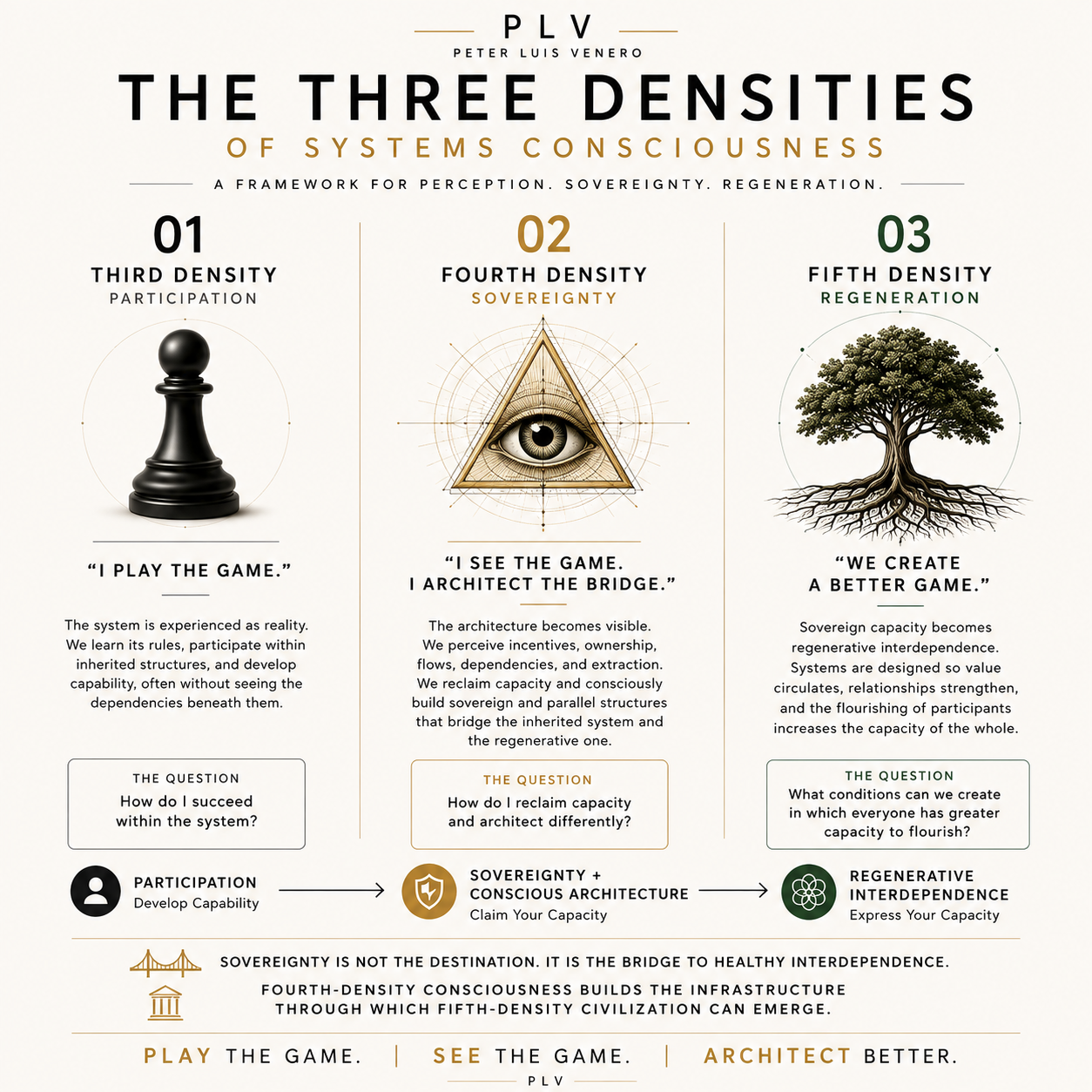
Third density is participation. The person plays the game.
Fourth density is sovereignty. The person sees the game.
Fifth density is regeneration. The person builds a better game.
Each depth contains the one before it. Each depth goes past the one before it.
Why This Matters
The structure of modern systems is no longer a neutral background. Modern systems are the main environment in which human capacity is either built or taken.
When a person cannot see the structure, the person works inside it. The person feeds algorithms that were not built for human growth. The person accumulates inside structures that concentrate power and spread fragility. The person confuses access with ownership. The person confuses growth with health.
When a person can see the structure, the person has a choice. The person can use public infrastructure without becoming dependent on it. The person can use platforms for discovery and still build owned relationships. The person can use financial systems and still understand their incentives and counterparty risk. The person can design entities, contracts, governance, intellectual property, fiduciary structures, reserves, data, and relationships on purpose, for long-term resilience.
Sovereignty here does not mean isolation. It does not mean exemption from the law.
Sovereignty means the person has enough understanding and enough capacity to choose what to depend on.
Systems literacy becomes sovereignty.
Sovereignty held long enough becomes something else. It becomes a question of what the person owes to the systems the person is now able to build.